
 ljhxx
ljhxx Most traders don’t land on leveraged ETFs by accident. They’re here because they want movement – fast, aggressive, high-reward movement. But that kind of exposure brings a question that many avoid until it’s too late:
How do you trade a 3x ETF without letting it trade you?
With leveraged funds like TQQQ and SQQQ, you can’t see timing as a “nice-to-have” – because it’s the entire game! These ETFs are built to magnify short-term trends, but that same design also makes them sensitive to volatility, resets, and intraday whipsaws. That’s why your strategy matters. Whether you’re opening a swing trade or holding for days, the difference between profit and pain lies in how you approach it.
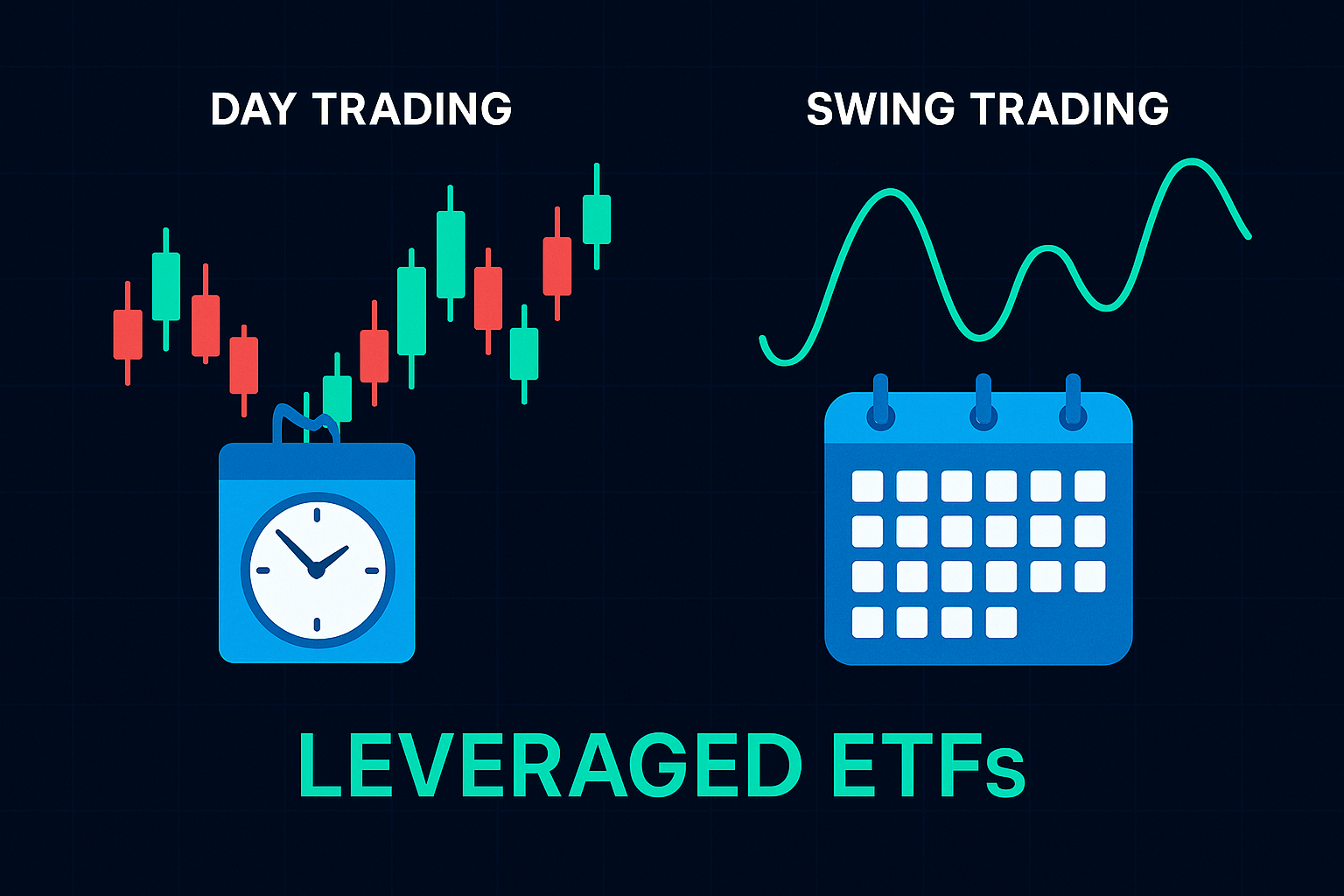
In this guide, we’ll break down two popular trading strategies: day trading leveraged ETFs and swing trading TQQQ or SQQQ. We’ll compare their pros and cons, the kind of setups they need, and which matches your trading style more. So if you’ve been wondering which route makes more sense for your style, pace, and screen time, you’ve come to the right place. Let’s break it down.
Day Trading Leveraged ETFs – Accuracy, Speed, and Constant Focus
If you’re looking for adrenaline, day trading leveraged ETFs is where it lives. TQQQ, SQQQ, SOXL – they all move with intensity, especially in the first and last hours of the session. But intensity alone doesn’t equal opportunity. What separates consistent day traders is their ability to control the noise and wait for precise setups to line up.
How Day Trading Leveraged ETFs Works
● Tight Windows, Clear Structure
Most day trades in TQQQ revolve around early breakouts or late fades. The goal isn’t to identify & catch the whole trend. It’s to grab a piece of momentum before it burns out.
● Defined Risk Per Trade
Every position starts with a fixed stop. Whether that’s 0.5% or 2%, it depends on the volatility. But no guessing. The stop loss is there before the order even goes live.
● Capital Rotation
Successful traders don’t babysit trades overnight. Instead, they reset their capital each day, giving them the flexibility to move fast without compounding the risk.
Key Requirements For Successful Day Trading Leveraged ETFs
● Screen time
There’s no way around it. If you’re trading TQQQ or SQQQ intraday, you have to be present to catch the opportunities when they present.
● Fast Decision-making
Indexes like NASDAQ-100 are well-known for moving fast. These funds can swing 2-5% in minutes. These funds can swing 2-5% in minutes. A delayed exit can wipe out an otherwise perfect entry.
● Tight Technicals
This means knowing how to trade around VWAP, previous day’s high or lows, or opening range breaks.
Pros of Day Trading Leveraged ETFs
– No overnight exposure
Since you’re ending trades on the day close, you’re safe from any overnight exposure. This means having no worries about your trades being affected by daily reset and volatility decay.
– You get to open more trades
Day trading leveraged ETFs gives you a chance to open more trades. When you open more trades, it typically means you get more chances to adapt. So even if your morning setup fails, you can always leverage another one in the afternoon.
– You get a clear structure
Day trading gives you a clear structure. You go in and take your exit as soon as you TP hits or you notice the trend moving against you. You’ll notice your logbook reflecting the continuous hits of TP.
Cons of Day Trading Leveraged ETFs
– High Emotional Toll
Seeing more screen time is a key requirement for successful day trading leveraged ETFs, it takes a high emotional toll on you. You’re on the clock the entire season, which means you’re constantly monitoring your positions and looking for better setups.
– Can lead to overtrading
Opening more trades in day trading is generally good and gives you a chance to take more TPs and spot more successful setups. But it’s crucial to know that there’s a fine line between opening more trades and overtrading. When we talk about day trading leveraged ETFs, you’re going to be seeing more movement given that you’re monitoring charts the whole day. This movement will make it tempting for you to force a setup that isn’t there, leading to overtrading.
Escape the 9-5 Grind: Master Day Trading with 3x ETFs for $500 Daily
An Example Setup For Day Trading Leveraged ETFs
Let’s say you’re watching TQQQ in the open after a strong pre-market gap. Your setup? Break above pre-market high with volume confirmation. For instance, take an entry at $52.80. Put a stop loss at $51.90, and TP at $54.10. However, there’s one important detail to keep in mind: Ensure you’re not holding beyond the morning session.
That’s what TQQQ day trading rules look like – clear, fast, and disciplined. Let’s look at swing trading next.
Swing Trading Leveraged ETFs – Patience, Planning, and Context
While day traders hunt in short bursts, swing trading TQQQ or SQQQ is about playing a broader setup. You’re not looking for a scalp trade. You’re positioning for a move that could stretch over 2-10 days, and sometimes even longer.
The difference?
You’re letting the chart take a breather. And that means you’ll also need to give your trades some breathing room, too.
How Swing Trading Leveraged ETFs Works
● Trend-based entries
Swing setups typically emerge from larger structures – a bounce off the 21 EMA, a breakout from consolidation, or even a clean reversal from oversold territory.
● Wider Stops, Bigger Picture
You’re not trying to nail the exact bottom. You’re catching momentum in the second or third act. So the stop-loss sits further out, and your conviction needs to be stronger.
● Fewer Trades, But More Calculated
Unlike day trading, setups don’t show up in every session. But when they do, you must make a calculated move when sizing your position.
Pros of Swing Trading Leveraged ETFs
● Less Screen Time
Considering that a swing trade can last anywhere between weeks and a month, it doesn’t require constant management, unlike day trading. As a trader adhering to swing trading leveraged ETFs, your job is to occasionally monitor your position instead of being glued to the screen all day.
● Better Capital Utilization
Since you’re opening calculated trades, swing trading automatically moves away from the concept of taking multiple trades in day trading. When you open limited trades, you’re letting your trade work for you while focusing on other setups or projects.
● One Breakout Could Lead To Big Profits
Swing trading requires sustaining your market direction. If the charts start going your way, one solid breakout can pay for multiple weeks of waiting.
Cons of Swing Trading Leveraged ETFs
● Overnight Risk
News, earnings, or macro events can shift direction while you’re not watching. These shifts can eat into your profits and eventually affect them.
● More Prone To Emotional Trading
When the trend starts going back and forth, your unrealized profits will start fluctuating too. Seeing these profits fluctuate will require a lot of discipline not to close the trade on minimal profit or at a loss.
TQQQ Swing Trading Strategy VS Buy and Hold
Example Swing Trading Leveraged ETF Setup
SQQQ has been consolidating after a steep drop. You spot a bullish divergence on the daily chart. Your thesis: If the market pulls back, SQQQ should spike. You enter the market at $12.40, place the stop loss at $11.8, and target at $14.00. You’ll need to size the trade moderately, knowing this trade might take 4-6 sessions.
That’s where SQQQ swing trading tips come into play – know your levels, trust your thesis, and don’t panic at the first dip. Swing trading offers structure, but it also tests patience. And when the market flips from trending to choppy, that’s where the strategy starts to matter more than your trading style.
Day Trading Vs. Swing Trading: Which One Works Better For You?
There’s no universal winner between day trading leveraged ETFs and swing trading them. It all comes down to how you leverage the information, handle risk, and manage your time.
| Factor | Day Trading | Swing Trading |
| Time Commitment | High – requires full attention during market hours. | Moderate – check-ins 1-2x per day |
| Holding Period | Minutes to hours | Several days to weeks |
| Typical Targets | 1-3% per trade | 5-15% per setup |
| Risk Profile | Fast-moving, tighter stops | Wider stops, overnight exposure |
| Emotional Load | Frequent decisions under pressure | Requires patience and conviction |
| Best For | Quick thinkers, technical scalpers | Pattern readers, traders that follow trends |
TQQQ day trading rules demand speed. You’re managing execution, momentum, and volatility in real-time. If you hesitate, the move is gone. If you chase, the losses compound fast.
Swing trading TQQQ, on the other hand, rewards foresight. You study the setup, wait for confirmation, and then let the trade unfold. But that also means trusting your analysis.
Now, let’s get real. Most traders sit on the fence while they evaluate which side of the grass is greener. Some prefer the intensity of a 15-minute chart. Others enjoy waking up to a position that’s up 7% without touching it. The difference isn’t in the setup – it’s in how you manage the risk around it.
Regardless of which route you choose, the key lies in knowing your strategy inside out. You can’t play a short-term leveraged ETF strategy with long-term conviction. And you shouldn’t hold a swing setup like it’s a scalp.
Let the charts decide what to trade, but let your strengths decide how to trade it.
Sharpen Your Edge With Sigmalerts
Whether you’re managing a 3-minute breakout or holding through a 5-day retracement, your edge comes from timing. And that’s exactly where Sigmalerts fits in. Built for traders who deal with speed, leverage, and volatility, Sigmalerts delivers real-time signals using AI and insights from seasoned traders.
With Sigmalerts, you get:
– Clean entries backed by momentum cues.
– Exit alerts before decay sets in
– Confirmation signals that match your timeframe.
If you’re day trading leveraged ETFs, you already know the first five minutes can set the tone. Sigmalerts lets you know when volume spikes align with trend continuation – before the crowd catches on.
Similarly, if you’re swing trading TQQQ, a delayed reaction can eat your profit. Sigmalerts helps you stay ahead of breakdowns, retests, and breakout failures. It’s not just noise filtering – it’s precision.
Whether you day trade or swing trade, Sigmalerts provides the signals you need to make informed decisions. After all, if your strategy depends on timing, your tools should too.
Final Words
There’s no universal playbook for leveraged ETF strategies. Some traders thrive in the rapid fire of intraday charts. Others prefer watching setups unfold over multiple sessions. But whether you lean toward day trading leveraged ETFs or find comfort in swing trading TQQQ, one thing stays consistent: the need for structure.
That’s why the strategy you choose should align with how you process risk. A thorough read of this blog will help you understand which trading option suits your style most. Stay sharp, trade well.